
Meat Sommeliers
Explain cuts and the effects of aging in greater detail and classify them based on sensory characteristics.
A specialized system in Sensory-ID™

AGE-TO-CUT™ combines animal age, muscle structure, maturity, and culinary purpose into a scientific decision-making system.
An animal's age does not affect every muscle in the same way. That is why AGE-TO-CUT™ takes into account the specific muscle, its structure, its current stage of maturation, and its intended culinary use.
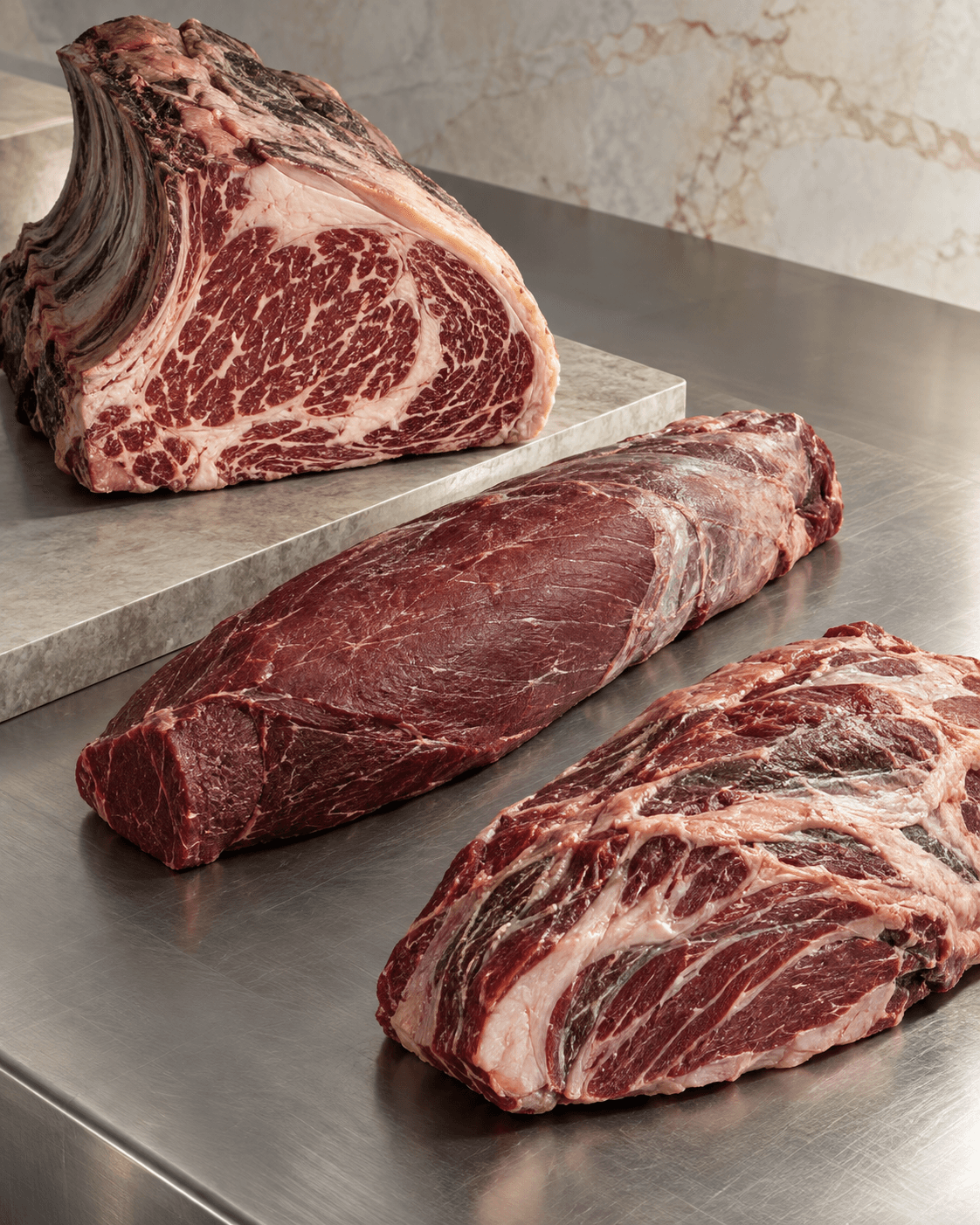 Three muscles. Different structures.
The specific muscle is the central focus of the AGE-TO-CUT™ approach.
The Problem
A blanket definition of “age” is too simplistic. What matters is which muscle is being considered and what culinary purpose it is intended to serve.
Age alone is not the deciding factor. What matters is which muscle is being considered, how its structure responds to age, the degree of maturation, and the intended use of the meat.
From General Judgments to Classification
AGE-TO-CUT™ brings together information that is often considered separately in the meat industry.
AGE-TO-CUT™ in Sensory-ID™
Fundamentals, technical documentation, and interactive applications are all intertwined.
The system page explains the concept, terminology, model architecture, and technical relationships.
Understand why an animal's age alone is not enough.Technical FundamentalsThis dossier documents the fundamentals, sources, derivations, levels of evidence, open questions, and limitations.
Understand the basis for statements and inferences.Documentation and SourcesThe matrix translates technical fundamentals into a nuanced analysis of meat type, cut, age, cooking goal, and aging.
Apply, compare, and interpret relationships from a technical perspective.Interactive ApplicationHow It Works
AGE-TO-CUT™ places the starting point, technical classification, and culinary uses within a shared context. In this way, individual factors are not considered in isolation, but rather in terms of how they interact with one another.
Three levels of analysis connect the starting point with the culinary goal.
The species and stage of development form the biological starting point.
Structure and product condition are evaluated on a muscle-by-muscle basis.
This classification refers to the intended culinary use.
Transparent Classification
AGE-TO-CUT™ not only presents expert opinions, but also explains what they are based on and how reliably they can be classified.
Missing data is not replaced by apparent certainty.
Parameters are provided only when there is a solid basis for them. Data gaps and uncertainties remain visible.
Professional Practice and Education
Explain cuts and the effects of aging in greater detail and classify them based on sensory characteristics.
Consider individual cuts more specifically in terms of aging, trimming, and intended use.
To better align muscle, product condition, and culinary purpose.
Convey technical concepts clearly and establish comparisons in a way that is easy to understand.
Convey complex relationships in a structured and interactive way.
Structure comparisons more systematically and document assumptions transparently.
Establish a differentiated relationship between the animal, age, muscle, and intended use.
Distinguish between sound foundations for uncertainties and data gaps.
Clearly distinguish between findings, synthesis, inference, and hypothesis.
Part of Sensory-ID™
With a Sensory-ID™ account, you gain access to a digital workspace for meat sensory analysis, knowledge, evaluation, aging, and culinary applications. The specific features available depend on the type of account you choose.
AGE-TO-CUT™ adds a muscle-specific perspective to sensory analysis, knowledge-based work, and culinary applications.
Access and Use
The current Sensory-ID™ login page will direct you to the available options for individuals, teams, schools, and educational partners.
Questions and Answers
Here you'll find the most important information about the system, how to use it, and how to access it.
AGE-TO-CUT™ is a specialized decision-making and knowledge system within Sensory-ID™. It combines animal species, age, muscle, structure, maturation, and culinary purpose.
No. The complete AGE-TO-CUT™ system, including the system page, dossier, and matrix [beta], is available exclusively in the restricted Sensory-ID™ area.
AGE-TO-CUT™ is used within the Sensory-ID™ digital workspace.
Yes. A valid Sensory-ID™ account is required to use the full system.
The system includes the AGE-TO-CUT™ System, the AGE-TO-CUT™ Dossier, and the AGE-TO-CUT™ Matrix [beta].
No. The AGE-TO-CUT™ dossier is proprietary technical documentation within Sensory-ID™.
This notation indicates that the interactive matrix is being further developed from a technical standpoint and updated as more data and insights become available.
No. AGE-TO-CUT™ distinguishes between scientific findings, literature-based synthesis, expert inference, sensory validation, and beta hypotheses.
Statements are categorized according to their scientific basis. This ensures that findings, synthesized literature, scientific inferences, and hypotheses remain distinguishable.
The same reliable data is not available for every category. Missing values are not filled in arbitrarily but remain visible as data gaps.
The available scope is displayed in the system and is being further developed based on the relevant data. The public site deliberately does not list any unconfirmed information.
Sensory-ID™ offers access options for individuals, teams, schools, and educational partners. The appropriate plan can be determined via the current access page or by contacting us directly.
The appropriate access depends on the type of use and the target audience. The official assignment is made via the current Sensory-ID™ access page or through direct contact.
Yes. AGE-TO-CUT™ is continuously refined as more data becomes available, findings are documented, and expert reviews are conducted. Uncertainties remain apparent throughout this process.
Next Step
Discover a digital workspace that seamlessly integrates animal age, muscle structure, maturation, sensory analysis, and culinary objectives.