M.E.A.T. GmbH — Meat, Education, Ambition, Travel
DKA Coreflex® Training with Hands-On Practice

Understand DKA Coreflex®. Use it. Teach it.

Core temperature is not a single value. It is a dynamic process.

Learn why cooking processes cannot be explained by a fixed target temperature. The DKA-Coreflex® training course combines an understanding of dynamic core temperature analysis with hands-on application using real products.

Understanding ProcessesApply it to the productShare knowledge
Understand · Apply · Teach
Why a Target Temperature Alone Is Not Enough

Two products can reach the same core temperature and yet yield completely different results.

Initial temperature, product structure, ripening, water content, fat, time, and heat input all influence the entire process. DKA Coreflex® therefore considers not only the final value but also the progression leading up to that value.

The shift in thinking begins when the question is no longer simply: What number should be achieved? What becomes crucial is how this specific product behaves when energy is applied.

Original DKA-Coreflex® illustration showing the difference between a reference value and a dynamic analysis.

Static value or dynamic process

Select a perspective. This illustration explains the conceptual model and does not perform any calculations.

A value

Static Analysis

A target temperature stands on its own.

The temporal progression remains invisible. Different products appear comparable, even though their structure, initial state, and heat input may differ.

What factors determine the outcome?

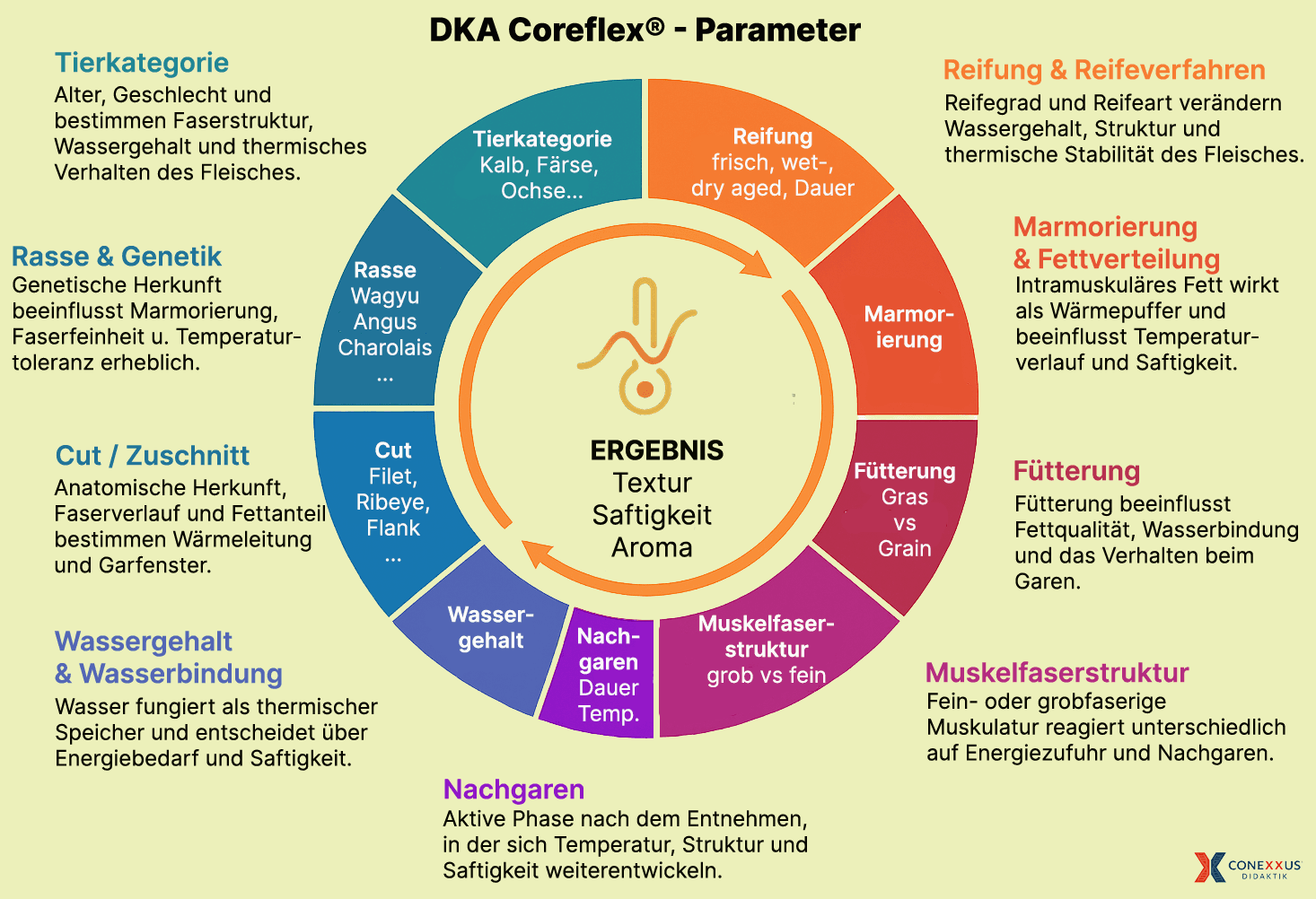
DKA Coreflex® does not treat these factors as an isolated checklist. What matters is how they interact in the actual cooking process.

Original DKA Coreflex parameter model, including animal category, breed, cut, water content, post-cooking, muscle fiber structure, feeding, marbling, and aging
The original DKA-Coreflex® parameter model illustrates the technical levels that collectively influence the cooking process.
01

Assess the Initial Situation

The product's condition, initial temperature, intended application, and existing process conditions form the starting point. Only once these conditions are clear can the subsequent course of action be meaningfully assessed.

02

Determine Product Identity

Animal category, age, sex, hormonal status, breed, and genetics influence fiber structure, fat distribution, water content, and thermal behavior. Classification therefore begins with the specific product.

03

Evaluate Structure and Connective Tissue

Muscle fiber structure, anatomical cut, connective tissue, cut, shape, and thickness all affect heat conduction, the cooking window, and the product’s response to heat input.

04

Consider Aging, Water, and pH

The degree of ripeness and ripening methods affect structure and water reserves. Water-holding capacity and pH influence how energy is absorbed, stored, and utilized during the cooking process.

05

Classifying Fat, Marbling, and Fattening

Fat distribution and marbling act as heat buffers and determine juiciness and mouthfeel. Diet can also influence fat quality, water-binding capacity, and thermal behavior.

06

Understanding the Thermodynamic Process

The heat source, intensity, duration, heat conduction, and temperature gradient determine how the product develops. Post-cooking and the resting phase are active parts of the process.

07

Evaluate the Process and Results

It is not just the temperature reached that matters. Temperature trends, structural changes, juiciness, texture, and sensory impressions are all taken into account together.

From Raw Material to Performance Evaluation

Each phase raises a different technical question. Together, they provide a clear path through the cooking process.

What is the situation?

Product

Clarify the product's identity and intended use.

The type of meat, cut, texture, aging, and fat distribution form the technical foundation of the cooking process.

Understand, measure, observe, evaluate

The training goes beyond theory. The concepts explained earlier are immediately applied to real products and cooking processes.

Participants observe temperature trends, compare conditions, evaluate changes, and use this information to make well-reasoned decisions for their own practice.

Technical IntroductionJoint AnalysisPractical ImplementationMonitoring ProgressTechnical and Sensory EvaluationApplication to Other Products

Understand, Apply, Teach

The three levels build on one another. Select a level to see how it contributes to the learning process.

01

Understand

Gain a technical understanding of the principles behind dynamic core temperature.

This conceptual model integrates product, structure, aging, water, fat, heat, and time into a well-reasoned analysis.

Knowledge that works in practice

A robust understanding of dynamic cooking processes
The ability to interpret specific temperature readings in a technical context
A structured look at the product, heat, time, and results
Practical experience with using the system
A clear methodology for your own work
The ability to explain the principle to others in a way they can understand

For professionals who want to gain a deeper understanding of cooking processes

Subject Matter Experts and Instructors

Explain dynamic cooking processes in an understandable way and teach them through real-world tasks.

Meat Sommeliers

Effectively integrate product structure, sensor technology, and temperature profiles.

Technical schools and educational institutions

Combine expertise with measurement, application, and joint evaluation.

Butcher Shops and Meat Processing Facilities

Derive process decisions based on product status and process conditions.

Product Development and Quality Assurance

Observe experiments in a structured manner and organize the results in a way that is easy to follow.

Barbecue schools and professional course providers

Supplement hard data with an explainable, practical understanding of the process.

Users with technical expertise

Gain a more nuanced understanding of cooking processes and apply that knowledge to new situations.

Dynamic Core Temperature Analysis According to Ronny Paulusch

Developer and InstructorRonny Paulusch

In DKA Coreflex®, Ronny Paulusch combines meat quality, sensory evaluation, aging, and cooking processes with a practical approach to knowledge transfer. During the training, he is responsible for providing technical context and ensuring direct application of the material.

Meat QualitySensory EvaluationAgingCooking ProcessesPractical Knowledge Transfer

Technical training with immediate practical application

The topics, products, framework, and practical exercises are tailored to the specific needs of your company, educational institution, or course format.

Dates and scheduling by appointment.

In your inquiry, please briefly describe the reason, the target audience, and the intended context of use.

Request DKA-Coreflex® Training

Don't just control cooking processes. Truly understand them.

DKA Coreflex® combines expert analysis with immediate practical application. Request training for your company, educational institution, or professional course format.

Request Training