
Don't guess
Relevant product and process characteristics are systematically recorded before a recommendation is made.
For this exact cut. Not just any cut. The DKA Coreflex® web app uses the meat’s actual characteristics—from aging to the cooking process—to provide a well-founded recommendation that can be applied in the kitchen, at the grill, in production, and in training.
You don't just get a number. You get the process from the starting product to the desired result.

The Application
Meat cannot be reliably reduced to a single numerical value in a table. The type of animal, category of animal, cut, breed, aging, water-holding capacity, fiber structure, marbling, diet, and thickness all affect how a product behaves when heated.
DKA Coreflex® considers raw materials, structure, process, and the desired end result in their entirety. This transforms a general temperature specification into a technically sound decision tailored to the specific product.
Relevant product and process characteristics are systematically recorded before a recommendation is made.
Different cuts of meat are not cooked to the same fixed internal temperature.
The recommendation is explained and can be understood based on one's own professional judgment.
Those who understand why a recommendation is made can classify it more reliably, document it, and apply it to similar situations.
Five Steps
The application guides users through a clear sequence of steps. Each step builds on the technical context until individual pieces of information come together to form a practical strategy.
Animal species, animal category, cut, and other characteristics form the specific starting point. The analysis begins with the actual cut of meat, not with a general table.
Six input fields
The target temperature is not estimated in isolation. It is determined based on the characteristics of the specific cut of meat, its structure and aging, the planned process, the desired result, and professional judgment.
Species, category, breed, cut, and trim describe the actual materials being worked with.
Fiber, moisture content, marbling, and fat distribution influence heat conduction and sensory perception.
The degree of ripeness and the ripening process affect structure, water-holding capacity, aroma, and temperature profile.
Thickness, energy input, cooking method, and holding phase constitute the practical process control.
The degree of doneness and the sensory profile combine texture, juiciness, and aroma to achieve the desired result.
The technical classification takes the selected application into account and makes relevant process decisions transparent.
Analysis and Results
The analysis doesn't stop at a single number. It shows when samples are taken, how the product evolves afterward, and which process parameters are best suited to achieve the desired sensory outcome.
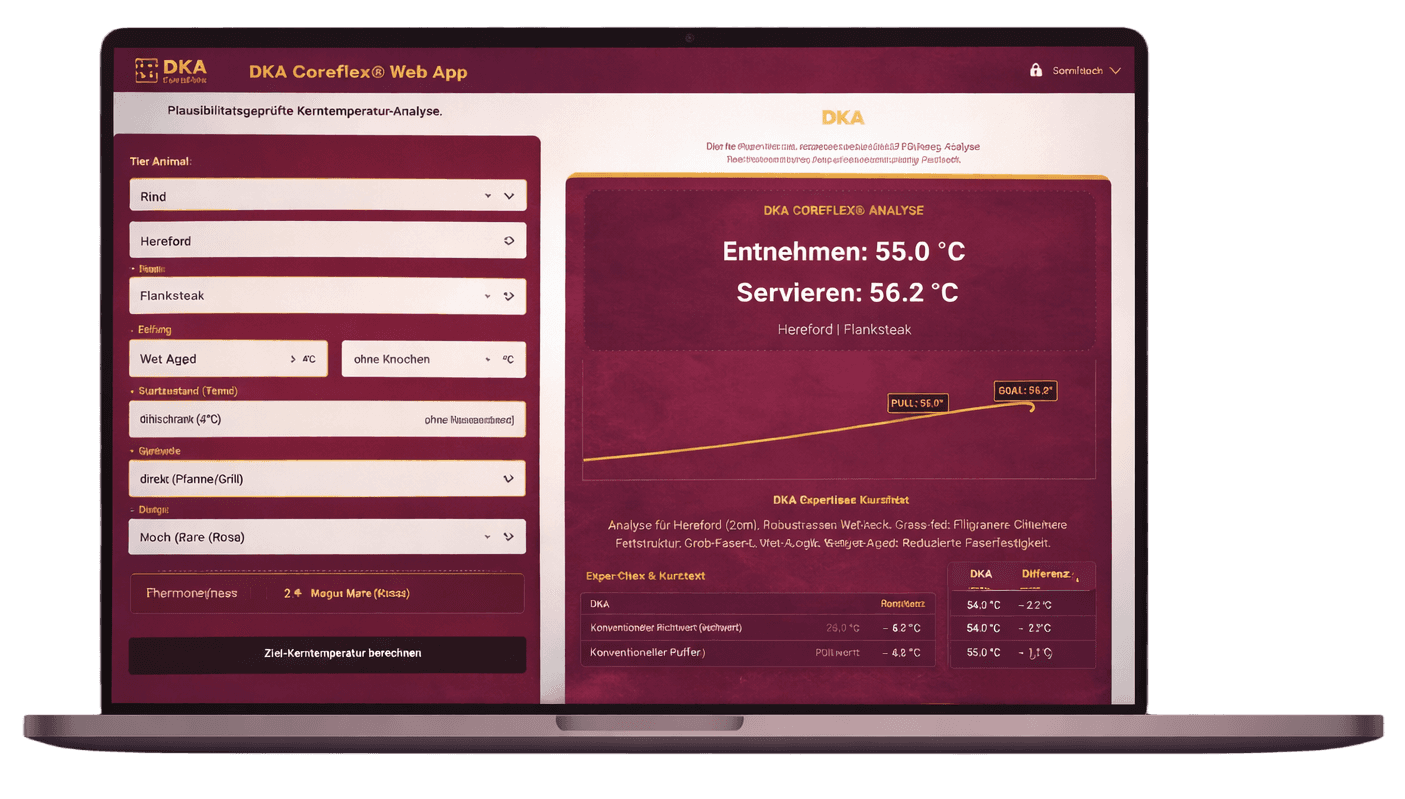
This issue combines the target range, sampling point, and post-fermentation with the method, timeframe, safety considerations, and the rationale for the recommendation.
Product profile, structure, maturation, energy input, and target profile are not considered in isolation. It is only their interaction that provides the technical context for the recommendation.
The app distinguishes between the target zone, the removal point, and the serving target. This makes it clear when a product is removed from the active heat and how it continues to cook until it is served.
The recommendation is not just an anonymous number. DKA Coreflex® explains which product and process characteristics influence the strategy and how the decision should be interpreted from a technical perspective.
Why this recommendation?
A simple temperature chart can provide a value. However, it does not explain why the same value leads to different results for different products. DKA Coreflex® reveals the technical relationships and links them to specific process control.
This allows the recommendation to be reviewed from a technical perspective, applied in practice, and documented for comparable products. It is precisely the rationale that distinguishes a well-reasoned cooking strategy from an isolated figure in a table.
Target temperature, removal from the oven, and post-baking are considered a single, integrated process.
Practical Benefits
The web app supports the process from the first look at the product to the documented result. It presents expert knowledge in a format that can be put to immediate use in everyday work, in development, and in teaching.
Two access routes
DKA Coreflex® can be used within the comprehensive Sensory-ID™ work environment. Users who wish to work specifically with the cooking strategy application are also provided with standalone access.
Integrated into a work environment for knowledge, profiles, analysis, and other tools. My Sensory-ID™ can be incorporated into the definition of objectives.
The standalone version is designed for users who want to work specifically with the DKA Coreflex® Cooking Strategy application. It is not a substitute for the full range of features offered by Sensory-ID™.
DKA Coreflex® Web App
Discover how product data, technical parameters, and the desired sensory outcome come together to form a clear cooking strategy.