
Starting material
What raw materials, structure, and intended application serve as the starting point?
CUSTOMIZED B2B PRACTICAL TRAINING FORMAT
M.E.A.T. combines expertise in aging, sensory evaluation, operational context, and proven application in a customized B2B format.
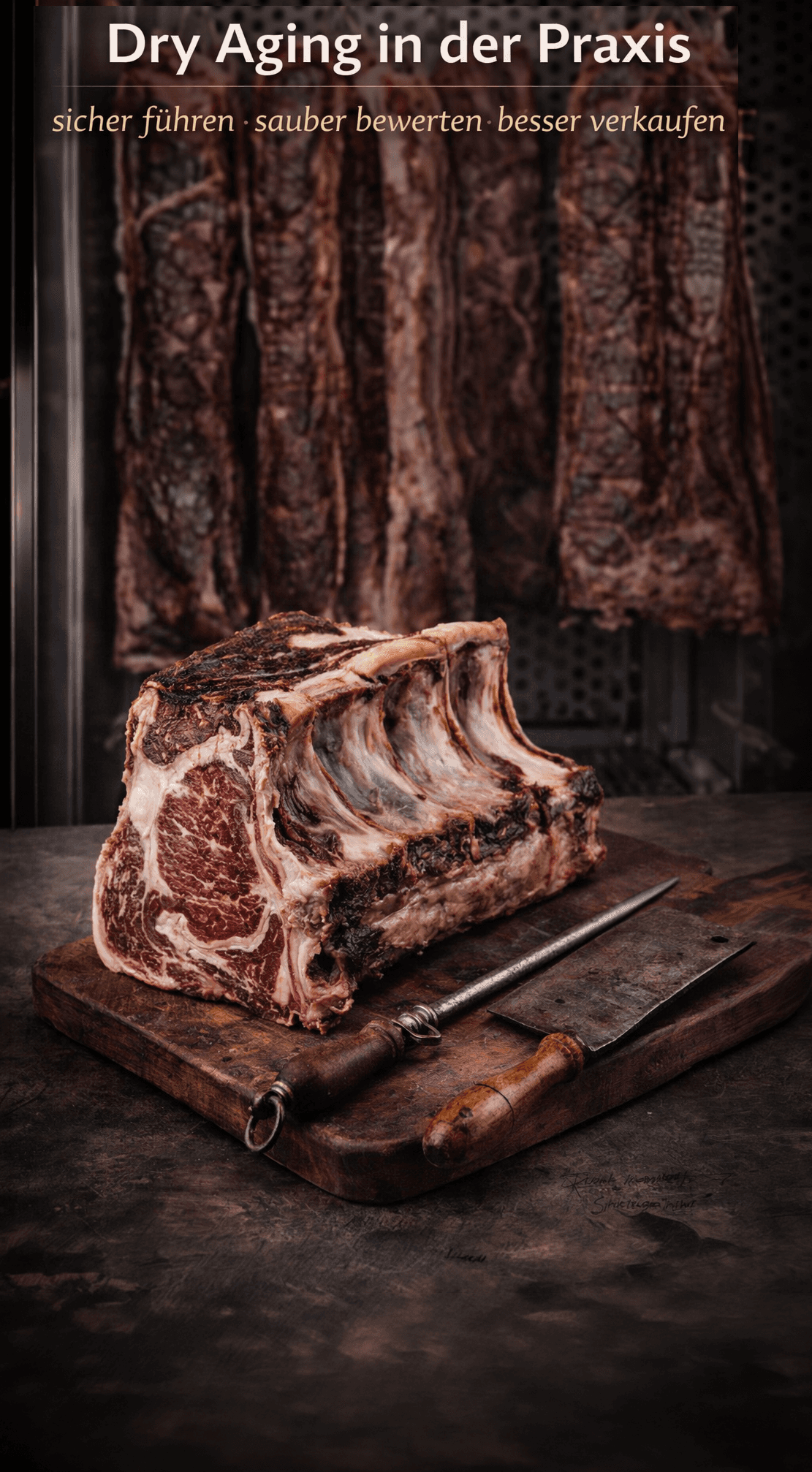
SUBJECT-SPECIFIC FRAMEWORK
The starting product, ripening conditions, time, surface, cross-section, smell, texture, aroma, and intended use must be considered in context.
This program is designed for companies and organizations that wish to gain a clear understanding of dry aging in terms of product appearance, quality, application, consulting, or operational practices. The scope, tasks, and evaluation are agreed upon on a project-by-project basis; this is not a licensing offer, nor is it available for direct private booking.
INTERACTIVE DRY-AGING PRACTICAL LAB
Select a field of work. Each perspective combines concrete analysis, professional relevance, business decisions, typical deviations, and the application of these concepts to your own practice.
Starting material selected.
What raw materials, structure, and intended application serve as the starting point?
The following factors are considered: cut, muscle structure, fat cover, marbling, surface, initial weight, and the intended future use. Suitability, potential, and limitations are professionally assessed before aging is used as a guarantee of quality.
The starting product determines which changes it makes sense to monitor. Only a clearly defined baseline can provide a reliable foundation for subsequent assessments of surface characteristics, weight loss, aroma, texture, and usable yield.
Goods receipt, cutting, initial weight, surface condition, and intended use are documented. Based on this information, the target maturity, key observation points, and a suitable basis for comparison for the remainder of the process are determined.
Typical issues include inconsistent cuts, damaged or severely dried-out surfaces, unclear pretreatment, missing baseline values, or a product that does not meet the specified maturity target.
Participants develop a repeatable incoming inspection process. They can explain why a product is considered to have reached a specific maturity level and which characteristics must be documented from the outset.
What time, climate, and process conditions are relevant to this specific task?
Maturation time, temperature, relative humidity, air circulation, loading, spacing, door openings, and operational procedures for the maturation cabinet are considered in relation to the product and the desired maturation goal.
Process conditions do not act in isolation. Their interaction influences surface development, water release, process stability, and sensory outcome. Therefore, the focus is not on a single target value, but rather on a process that is managed in a transparent manner.
The frequency of observations, appropriate measurement and inspection points, documentation, and criteria for a technical reassessment are defined. Measurements are always interpreted in conjunction with the product's condition and its progression over time.
Unstable climate conditions, improper loading, frequent door openings, condensation, uneven surface development, or missing records make evaluation difficult and may indicate process deviations.
Participants can monitor their existing tire technology more systematically, distinguish between various influencing factors, and identify deviations earlier within an operational context.
What can be observed in terms of surface, cross-section, smell, texture, and aroma?
Both external and internal characteristics of the product are observed: surface, color, cross-section, smell, texture, juiciness, and aroma. The observations are described in detail before conclusions about causes or quality are drawn.
Sensory analysis makes it possible to compare changes when observations are recorded in clear, precise language and under reproducible conditions. This separates personal preference from technical descriptions and business decisions.
Characteristics are identified, compared with references or previous observations, and evaluated in terms of maturity targets and application. Only then is a decision made regarding what further testing, documentation, or process adjustments are appropriate.
Unclear or inconsistent terminology, hasty claims about causes, a lack of control samples, an undocumented preparation method, or conflicting impressions can easily lead to misinterpretations.
Participants gain a common language for describing sensory changes. They can share their observations more clearly within the team and better compare results across multiple maturation stages.
Which deviation, change, or uncertainty requires technical clarification?
The process is interpreted as a series of observations. These include timestamps, weight trends, surface characteristics, climatic conditions, interventions, anomalies, and the relationship between raw material input, loss of ripeness, yield, and product appearance.
A single data point does not explain how a result came about. Regular monitoring lays the groundwork for detecting changes early, justifying decisions, and preparing more effectively for future developments.
A record is kept of what has changed since the last observation, whether the course of events appears plausible, and whether additional expert clarification is needed. Interventions and the reasons for them are documented in a way that ensures they remain traceable later on.
Incomplete records, varying measurement methods, missing time references, unclear responsibilities, or decisions based on gut instinct make it difficult to compare trends and complicate the identification of causes.
Participants develop a practical monitoring routine for their own operations. This allows for a more informed assessment of raw material usage, loss of ripeness, time, yield, quality, and marketing.
Which application must be demonstrated in practice, justified, and verified?
The assessment focuses not only on knowledge, but also on its clear application to a specific product or case. Participants describe the initial situation, the desired outcome, their observations, their decision, and the technical rationale behind their approach.
Only through practical application can we determine whether individual observations can be combined into a coherent overall assessment. This evaluation step clarifies understanding and lays the groundwork for constructive feedback.
The assessment focuses on the quality of the observation, the clarity of the documentation, and the professional rationale. The individual B2B framework may include formal proof of competence and a certificate following a review of professional application.
Typical weaknesses include unsubstantiated conclusions, omitted baseline values, a conflation of perception and cause, or recommendations that do not align with the documented maturity goal.
Participants can explain their own maturation decisions in a more structured way, make targeted use of feedback, and derive concrete starting points for the next stage of maturation from the results.
PRACTICAL MATURITY SKILLS
Practical maturation expertise means understanding the product, objective, conditions, process, and outcome as an integrated whole. In this context, technical knowledge is combined with sensory perception and verified application.
Raw material, cutting, structure, fat cover, and initial condition are described as a common basis.
The desired sensory and application-specific characteristics are clearly defined before the process begins.
Time, climate, airflow, loading, and monitoring frequency are determined based on the product and the operation.
Surface, weight, odor, color, and other characteristics are documented regularly and in a comparable manner.
The cross-section, texture, juiciness, and aroma are described, compared, and evaluated in relation to the desired level of ripeness.
Observations are synthesized into a well-reasoned professional decision and used to guide the next stage of development.
FROM RAW MATERIALS TO THE FINAL PRODUCT
The process establishes a consistent approach from selection through to the next stage of maturation. Each step is based on documented observations.
Clarify and document the product, initial state, objective, and basis for comparison.
Define curing conditions and establish transparent procedures for loading and operational workflows.
Monitor progress at defined intervals, record changes, and classify any anomalies.
Describe the results, compare them with the learning objectives, and provide a professional rationale for your decisions.
Document findings and define specific adjustments for the product, process, or objective.
COMMON QUESTIONS FROM PRACTICE
The answers are derived from the product, the maturation goal, the documented process, and the sensory evaluation. General rules are not sufficient in this context.
The answer does not begin with a generic bill of materials. The assessment takes into account the raw material’s condition, cut, structure, fat content, intended use, and the desired result. This leads to a well-reasoned selection for the specific operational task.
Desired changes are first described as a maturity goal and later assessed based on appearance, cross-section, smell, texture, juiciness, and aroma. The key factor is the relationship between the product, the development process, and its intended use.
Through regular visual, olfactory, and progress monitoring, consistent measurement methods, and documentation with clear time references. Any abnormalities are not evaluated in isolation but are compared with the starting product, ripening conditions, and previous changes.
Not as separate, individual values. The characteristics are documented throughout the process, described using sensory evaluation, and related to the target maturity, yield, and application. This makes it clear which changes occurred and when, and what decisions resulted from them.
It includes recurring observation points, clear product data, time references, consistent terminology, and a final evaluation. Good documentation also records any interventions, uncertainties, and the rationale behind the decision.
PRACTICAL EXPERIENCE RATHER THAN STANDARD TRAINING
The format is tailored to the target audience, level of experience, workplace, and available technology. It combines technical and sensory analysis with practical applications that remain relevant to the specific work context.
Product properties and observable characteristics are described, compared, and related to their application and quality criteria.
Raw material input, loss of ripeness, time, yield, quality, and marketing are taken into account where they influence operational decisions.
A practical assignment demonstrates whether technical concepts have been understood and can be applied in a clear and coherent manner. The agreed-upon demonstration of competence and the certificate are based on this project-specific framework.
Assignments, examples, and feedback are tailored to the participants' experience, areas of responsibility, and the maturity level of their existing technology.
WHO THIS FORMAT IS INTENDED FOR
WHAT REMAINS USEFUL IN THE BUSINESS
Maturation processes are viewed as a continuous progression rather than as a collection of individual values.
Changes can be described more precisely, discussed as a team, and aligned with a specific goal.
The initial situation, observations, interventions, and decisions remain available for later comparisons.
Products, processes, and maturity goals can be coordinated more effectively and further developed.
The practical exam and expert feedback reveal which concepts are already being applied confidently and where further clarification is needed. This provides concrete starting points for the product, process, documentation, and maturity goals.
PROTECTED SUBJECT SYSTEM
The Kaizen Aging™ Tire Navigator supports the technical classification of aging processes and decision-making. It is available in the Sensory ID secure area as a standalone module or as part of a package.
The system is classified as a specialized system. The secure navigator is part of the agreed-upon application and is not publicly accessible.
Learn About Kaizen Aging™ in Sensory IDSPECIFIC MATURATION TASK