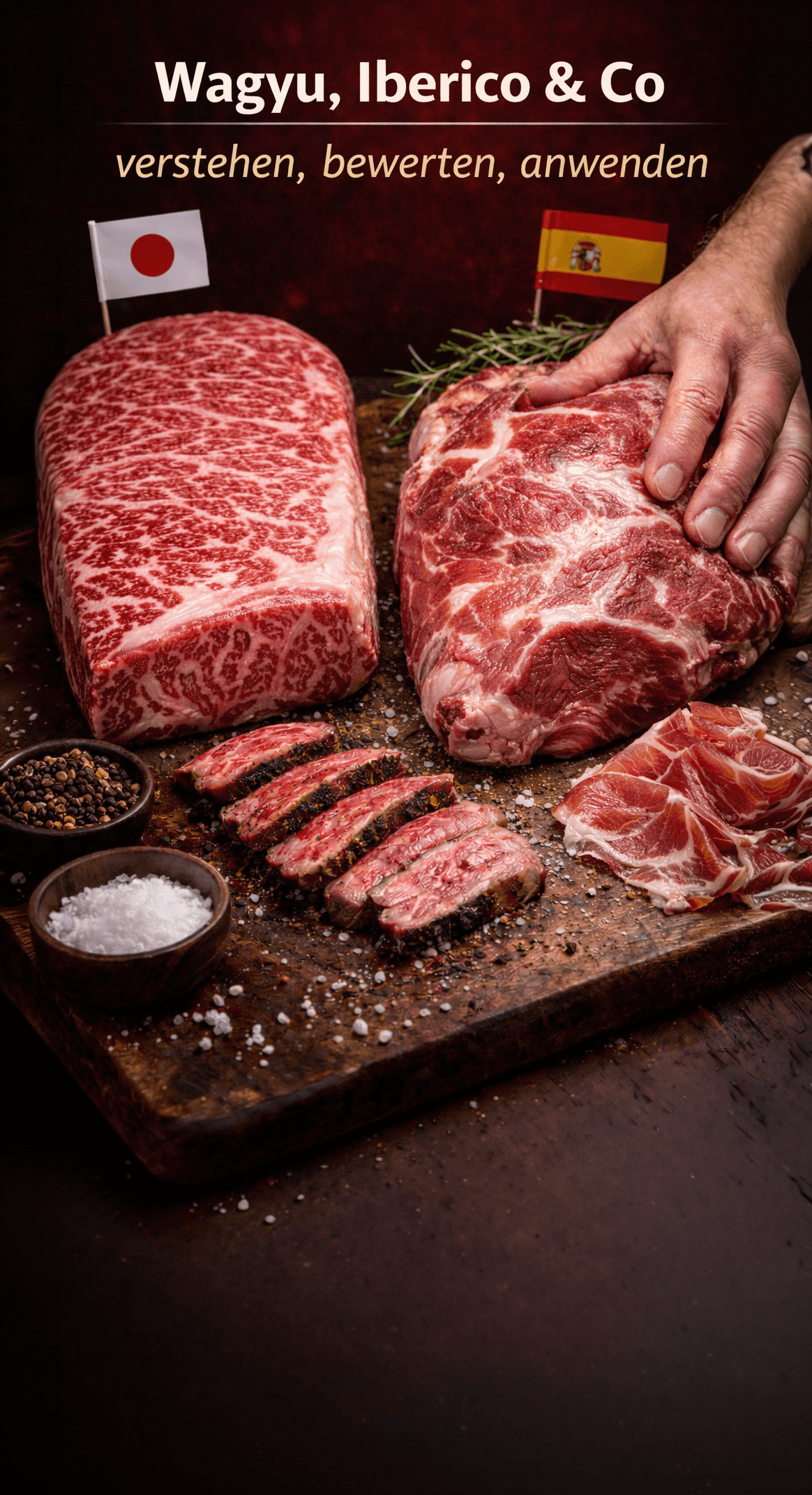
Wagyu.
Fat as structure.
Highly marbled beef requires an eye that takes into account origin, marbling, fat content, temperature, and portioning.
Two exceptional product lines. A robust journey from origin and fat composition to professional use.
For companies, technical schools, academies, associations, and educational partners that want to do more than just showcase premium products—they want to explain them in technical terms, compare them, and use them responsibly.

High-quality breeds are often classified as “luxury meat.” In everyday professional practice, however, a clear rationale is needed: What is genetics, what is feeding, what is aging, what is marketing, and what can actually be verified from a sensory and culinary perspective?
This format fosters discernment. It links origin and production systems to fat quality, flavor profile, aging, temperature control, preparation, and a language that also informs consulting, product selection, the kitchen, and product development.
Highly marbled beef requires an eye that takes into account origin, marbling, fat content, temperature, and portioning.
Ibérico combines origin, quality grades, characteristic cuts, aging, and a unique sensory profile.
Choose a perspective. Each view combines the product system, sensory impact, and practical decision. The comparison matrix also provides a quick overview.
Origin is more than just a place name. It encompasses genetics, rearing, feeding, quality levels, and the expectations a product generates in the market.
Japanese Wagyu serves as a benchmark. American, New Zealand, and German Wagyu broaden the comparison in terms of style, fat profile, and market relevance.
Spanish Ibérico ham is classified by experts according to Bellota and other quality levels, as well as 50, 75, and 100 percent. German quality standards provide a clear basis for comparison.
Japanese Wagyu serves as a benchmark. American, New Zealand, and German Wagyu broaden the comparison in terms of style, fat profile, and market relevance.
Spanish Ibérico ham is classified by experts according to Bellota and other quality levels, as well as 50, 75, and 100 percent. German quality standards provide a clear basis for comparison.
Marbling is not considered in isolation. The same visual intensity can produce a different sensory effect depending on the product system.
Fat quality, marbling, and melting characteristics define the texture and flavor profile. Ham and other processed meats illustrate this principle particularly well.
The reference sample establishes a baseline. Differences between soft, juicy, melt-in-your-mouth, and sensory overload become clear.
Fresh cuts and aged products require their own grading. Product families are deliberately tested separately so that impressions do not overlap.
Processed Wagyu products reveal both the benefits and limitations of processing. Criteria matter more than brand claims.
Iberian ham serves as the industry standard for aging, fat content, and flavor. Dry-cured products are classified in a transparent manner.
Correct preparation is contrasted with preparation that is too hot or takes too long. Texture and melt are described for the grill, skillet, and oven.
Temperature ranges and texture control demonstrate how juiciness, fat content, and serving temperature interact.
Ribeye, strip loin, and tenderloin are evaluated based on their fat content, portion sizes, and suitability for grilling, pan-frying, sharing, or inclusion in a meal.
Presa, Secreto, and Pluma highlight differences in texture, cooking time, and presentation.
This format is not a leisure event. The focus is on comparing, testing, calibrating, and drawing conclusions. The specific product selection and setup are tailored to the target audience and the project.
Comparison begins with the method, not the label. Cutting, portioning, salting, resting times, and sequence are coordinated in such a way that differences can be reliably observed.
Reference samples establish a baseline. Applying the same criteria to all samples helps ensure a consistent evaluation of fat content, mouthfeel, aroma, texture, and aftertaste.
"Correct" versus "too hot" or "too long" are contrasted. Core temperature, fat rendering, timing, resting, post-cooking, and serving temperature are effectively brought together.
Ribeye, strip loin, and tenderloin, as well as presa, secreto, and pluma, are not only named but also classified according to their fat content, texture, cooking window, and recommended uses.
Iberian ham, dry-cured products, and premium Wagyu products demonstrate the effects of aging and processing. Product value, portion sizes, and plausibility are discussed without resorting to myths.
Sensor data is transformed into a reliable recommendation. Teams learn to communicate product value, application, and expectations in clear statements and to avoid common misconceptions or overpromising.
Wagyu and Ibérico are challenging from a sensory perspective. Product families are deliberately evaluated in separate sessions to avoid overlap, fatigue, and incorrect conclusions.
The evaluation criteria remain consistent: aroma, texture, aftertaste, fat structure, mouthfeel, temperature effect, and practical suitability are documented using comparable criteria.
This format combines in-depth technical knowledge with practical application. This creates a common standard for people who select, process, explain, teach, or further develop products.
Common evaluation and language standards for the product lineup, product development, the kitchen, sales, and management.
A technically structured product comparison that consistently links origin, sensory characteristics, and application.
A distinctive professional format for discerning audiences and institutional continuing education.
A curated framework for presenting premium segments in a responsible, comparable, and practical manner.
Project-based implementation or a suitably agreed-upon framework for use and licensing.
Listing, consulting, complaint prevention, and realistic expectation management.
Evaluate quality, understand cutting logic, and correctly classify finishing processes.
Gain practical mastery of temperature ranges, fat behavior, cooking logic, and sensory effects.
Clearly explain the product's value, manage expectations, and avoid common misconceptions.
Ronny Paulusch leads the program as an instructor and program director. His experience in Japan and Spain serves as a reference for standards, product logic, and plausibility.
The focus is not on spectacle or myths, but on a clear and logical approach: establishing benchmarks, calibrating differences, describing sensory effects, and using this information to make sound decisions tailored to the specific professional context.
The proportion of in-person sessions, digital components, location, duration, group size, product selection, scope of services, and price are agreed upon on a project-by-project basis.
Digital preparation can standardize terminology, breed-specific criteria, fat quality, aging, and evaluation and language standards. It is not an automatically required component. Hands-on work can deepen understanding of direct comparison, sensory analysis, temperature control, and application. The combination is tailored as needed.
Identify Needs: Target groups, areas of application, and desired skill development are jointly assessed.
Defining Domain Architecture: Product systems, comparison logic, digital and practical components, and knowledge transfer are appropriately integrated.
Agree on the details: The location, duration, group size, scope of services, product selection, and price are clearly defined.
Clarify Terms of Use: Institutional licensing is possible within the appropriate framework. The scope, rights, quality assurance, and further development are expressly agreed upon.
The comparison uses clear benchmarks and a verifiable method. This way, differences are not just a matter of “intuition,” but can be clearly understood.
Japan, the U.S., New Zealand, and Germany for Wagyu and highly marbled beef. Spain and Germany for Ibérico and comparable qualities.
Bellota and other Spanish grades, as well as the classifications of 50, 75, and 100 percent.
Aroma, texture, aftertaste, fat structure, and mouthfeel are described using the same logic and calibrated against reference standards.
Temperature ranges, fat rendering, cooking time, resting time, proofing, and serving temperature are determined for grilling, pan-frying, and baking.
Portion sizes, product value, price perception, customer service, the menu, the product selection, and team briefings are responsibly integrated.
Discuss the target audience, subject matter focus, and the appropriate framework for project-based implementation or institutional licensing.