M.E.A.T. GmbH — Meat, Education, Ambition, Travel

B2B PRODUCT DEVELOPMENT

Develop products
that are both technically sound and practical.

M.E.A.T. supports companies, small businesses, and the food industry in developing new products and strategically enhancing existing products or product lines.

Raw materials, processing, sensor technology, applications, manufacturability, and economic factors are combined to form a robust development strategy.

Discuss the product development project
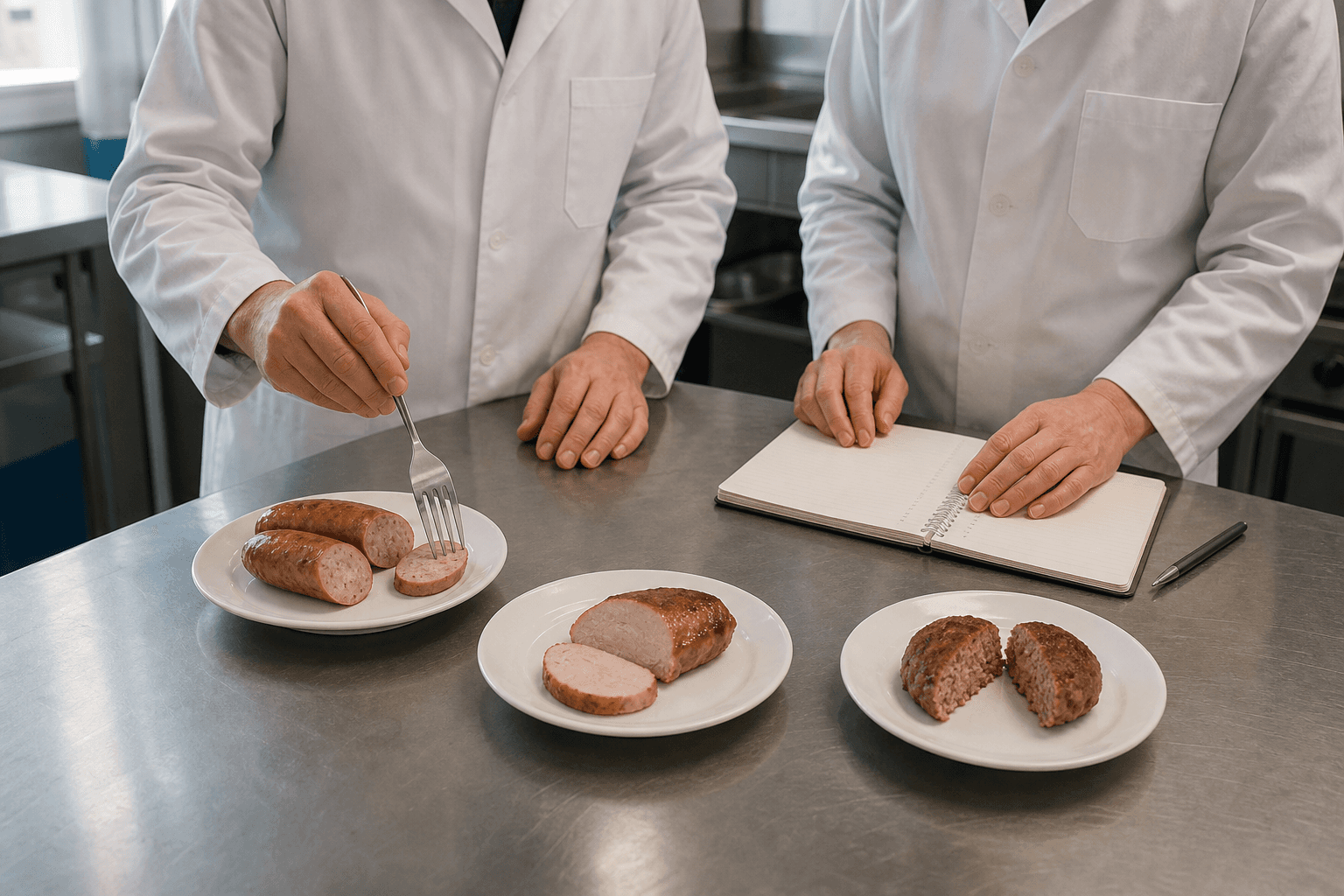
Technical evaluation of various prepared meat samples on a work table
Editorial stock photo.

Jointly define the development status of
.

M.E.A.T. supports product development up to a jointly defined development and handover stage. The scope, development phases, and handover points are determined based on the task, the product, and existing responsibilities.

Clarity, functionality, and quality are integrated from the initial concept through to this agreed-upon stage.

TWO STARTING POINTS


's assignment sets the direction.

Products don’t just happen by chance: they are conceived, tested, and consistently brought to life. Product development translates ideas and expertise into a functional product in a structured way—not into a concept that ends up gathering dust in a drawer.

Further Develop an Existing Product or Product Line

What should be preserved? Which characteristic or application should be changed? Quality criteria, as well as technical, sensory, and practical limitations, determine the appropriate direction for development.

Reasons for this may include quality that is difficult to explain, a product line that has evolved over time and lacks clarity, or high effort with little impact. The goal is to achieve quality that is technically verifiable and a clearly structured, focused product offering.

Develop a New Product

What purpose is the product intended to serve? For what application and target audience is it being developed? Raw materials, properties, quality characteristics, and manufacturing conditions provide a clear direction for the product concept.

A lack of differentiation in the market or uncertainty regarding launch and scaling are classified as development issues. For products and product lines, the target development and transfer status is explicitly agreed upon.

Not originality at any cost. What matters is the balance between ambition, feasibility, and benefit.

DEVELOPMENT NAVIGATOR

A different starting point.
A different commute.

Select your starting point and follow the corresponding guiding questions through the development process. Which stages are part of the assignment and how thoroughly they will be addressed will be determined on a project-by-project basis.

Highlighted key question: Your starting pointDepending on the project: Clarify the scope and participants together
  1. Background and Objective

    Clarify the task, purpose, target audience, and market environment; jointly determine the desired level of development.

    Further Development: What is already in place—and what should be deliberately preserved?

    New Product Development: What purpose should the new product serve, and for whom?

    Possible Work Status: A well-defined task and a jointly defined goal.

  2. Requirements and Quality Criteria

    Specify the function, benefits, and unique features. Define the criteria for assessing quality and suitability.

    Further Development: Whichproven features are considered the standard, and which ones should be changed?

    New Product Development: What characteristics does the product idea need to have in order to fulfill its purpose?

    Possible Work Status: Clearquality criteria instead of a vague product concept.

  3. Raw Material, Product, and Application

    Link the quality of raw materials, aging, processing, sensory evaluation, and preparation to their specific use.

    Further Development: Are the raw material and product properties suitable for the desired new application?

    New Product Development: Which raw materials and properties are best suited for the application and target audience?

    Possible Work Status: Coordinate raw materials, processing, and application in a technically sound manner.

  4. Direction of Development

    Consolidate insights to establish a well-founded direction: product logic, potential role within the product line, and clear communication.

    Further Development: How can a product line that has grown over time become clearer, more focused, and more distinctive?

    New Development: What function, what benefit, and what unique feature give the idea a clear direction?

    Possible Work Status: A clearly defined positioning and quality that can be explained in a transparent manner.

  5. Depending on the project

    Procedure and Process

    Assess processing methods, technical capabilities, feasibility, and practical manufacturing conditions, to the extent that they are relevant to the task.

    Further Development: What procedural adjustments make sense under the current conditions?

    New Product Development: What manufacturing conditions need to be taken into account early in the development process?

    Possible Work Status: Classify professionaland technical decisions, including the factors that influence them.

  6. Depending on the project

    Samples and Technical Evaluation

    Depending on the task, samples may be developed in collaboration with the client or a suitable manufacturing partner. M.E.A.T. can provide guidance on their technical and sensory evaluation in practical settings and applications.

    Further Development: How does a modified version compare to the existing product?

    New Development: What criteria can be used to technically evaluate function, sensor technology, and application?

    Possible Work Status: Evaluated observations as the basis for the next decision.

  7. Depending on the project

    Adaptability, Manufacturability, and Reproducibility

    Evaluate necessary adjustments and clarify the conditions for traceable manufacturing. There is no set number of samples or rounds of adjustments.

    Further Development: What needs to be adjusted to ensure that the desired change can be reliably implemented?

    New Development: Under what conditions can the valued approach be consistently implemented?

    Possible Work Status: Specify the conditions for consistency, manufacturability, and reproducibility.

  8. Transfer and Next Decision

    Document the current status of development, open questions, responsibilities, and upcoming decisions. Implementation, training, or further development will be agreed upon as appropriate for the task.

    Further Development: How is further development implemented in operations, sales, training, and day-to-day work?

    New Development: What is being handed over—and what decision needs to be made before the next implementation?

    Possible Work Status: A defined stage of development and transition with clearly defined handoff points.

The development path is intended to clarify the scope of work. It does not evaluate a specific product, nor does it define a complete scope of work, costs, or project duration.

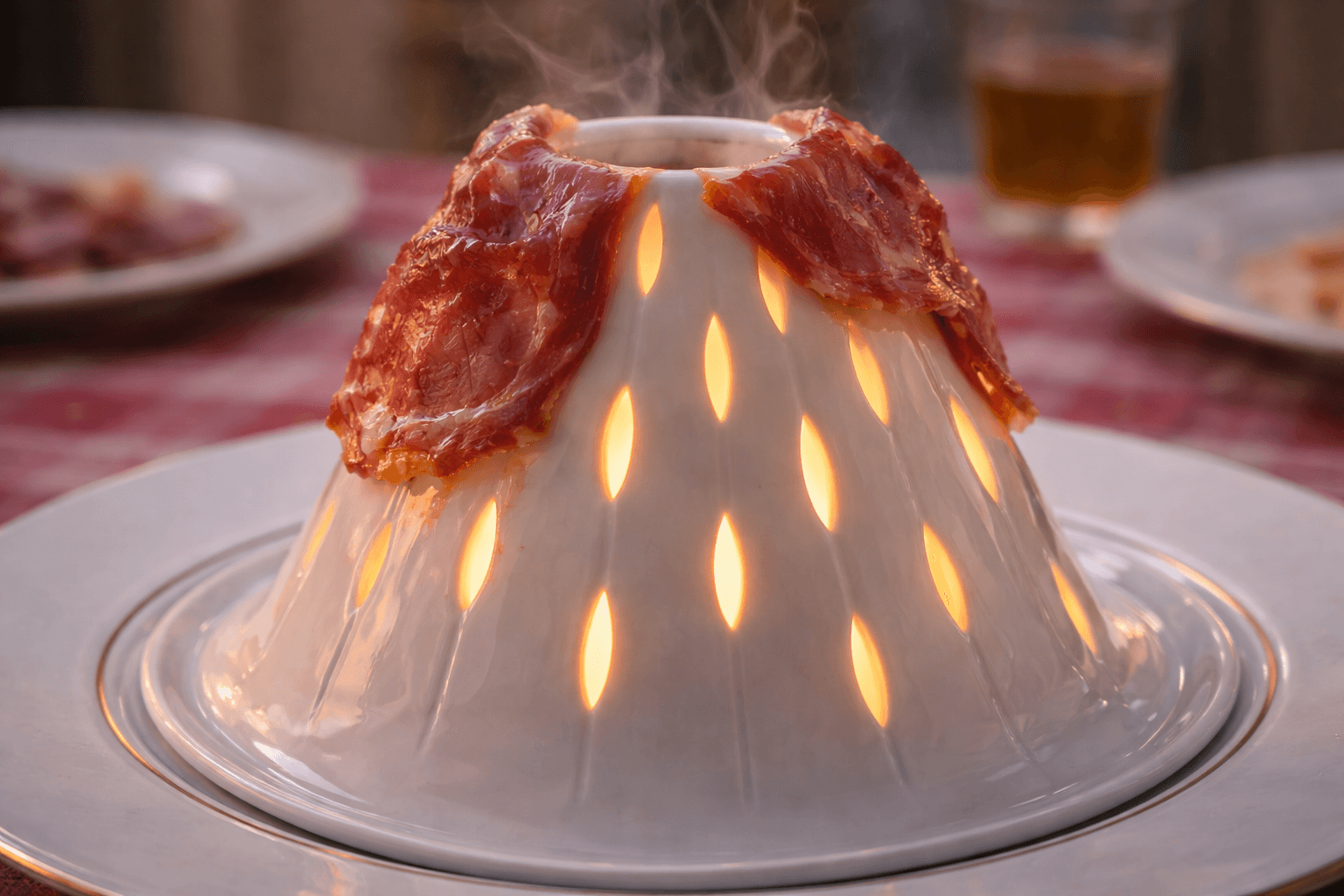
Porcelain ham volcano with slices of ham on top and warm lighting
Ham Volcano® · Product and Cultural Format

PRODUCT REFERENCE

Ham Volcano®

The Schinkenvulkan® draws on a well-known way of presenting ham. Ronny Paulusch has further developed and reinterpreted the basic concept from a technical perspective.

This product and cultural concept combines ham, craftsmanship, presentation, and education. It is ideal for cortadores, food connoisseurs, tapas bars, and restaurants, among others. Here, the product, its use, and the cultural context go hand in hand.

View Schinkenvulkan®

COLLABORATION, PARTICIPANTS, AND TRANSFER

Lead with expertise.
Moving forward together.

Good products are the result of clear decisions. Product development combines expertise, an understanding of the market, and the realities of craftsmanship—and with it, responsibility for content, function, and impact.

Customized Work Instead of a One-Size-Fits-All Solution

The client, M.E.A.T., and, if applicable, manufacturing partners will jointly determine their respective contributions. M.E.A.T. may be responsible for technical leadership and evaluation; prototype production and modifications will be organized on a project-by-project basis.

Product logic, raw materials, manufacturing processes, and quality form the technical foundation. The target audience, intended use, expectations, and market environment provide the context. The goal is to create technically sound, manufacturable, explainable, and reproducible products.

A practice that recognizes connections

Experience gained in the butchery trade, food retail, and continuing education is incorporated into our work. The quality of raw materials, aging, processing, sensory evaluation, preparation, and training are viewed as an integrated system.

Product development is neither purely a product idea nor mere marketing. Technical expertise, feasibility, and practical application must all align so that a product can function effectively in operation, sales, training, and everyday use.

Economic Factors

Cost, feasibility, and economic factors are taken into account where they influence the direction of development, manufacturability, and decision-making. This may also include the implications of future scaling.

This refers to the classification of professional and technical decisions, not a complete product or unit cost calculation, price approval, or guarantee of economic success.

Specialized Offices and Drop-off Points

Issues related to laboratories, food law, labeling, shelf life, packaging, production, or intellectual property rights are addressed with the relevant departments and partners as needed.

Laboratory analysis, shelf-life testing, packaging development, plant design, regulatory approvals, and full production validation are not automatically included in M.E.A.T.'s scope of work.

The agreed-upon transfer sets forth the current state of development, quality criteria, outstanding responsibilities, and next steps. Implementation, training, and further development may follow, but are not part of a comprehensive package that has been promised across the board.

PROJECT INQUIRY

What would you like to continue working on,
?

During the initial meeting, we clarify the current situation, objectives, product context, responsibilities of the parties involved, and the desired stage of development and transfer.

The scope, duration, and compensation depend on the objectives, level of responsibility, and complexity. The focus is on professional collaboration, a clear structure, and transparent results—not short-term effects.