M.E.A.T. GmbH — Meat, Education, Ambition, Travel

Understanding Products and Concepts

Understand products. Justify decisions with technical expertise.

M.E.A.T. analyzes products in terms of their origin, structure, processing, aging, sensory characteristics, and application. This provides a technical basis for decision-making regarding quality, product range, usage, and communication.

This service is designed for companies and organizations that want to realistically assess a product’s potential and limitations—before making further decisions regarding development, marketing, or training.

Discuss the product or concept brief
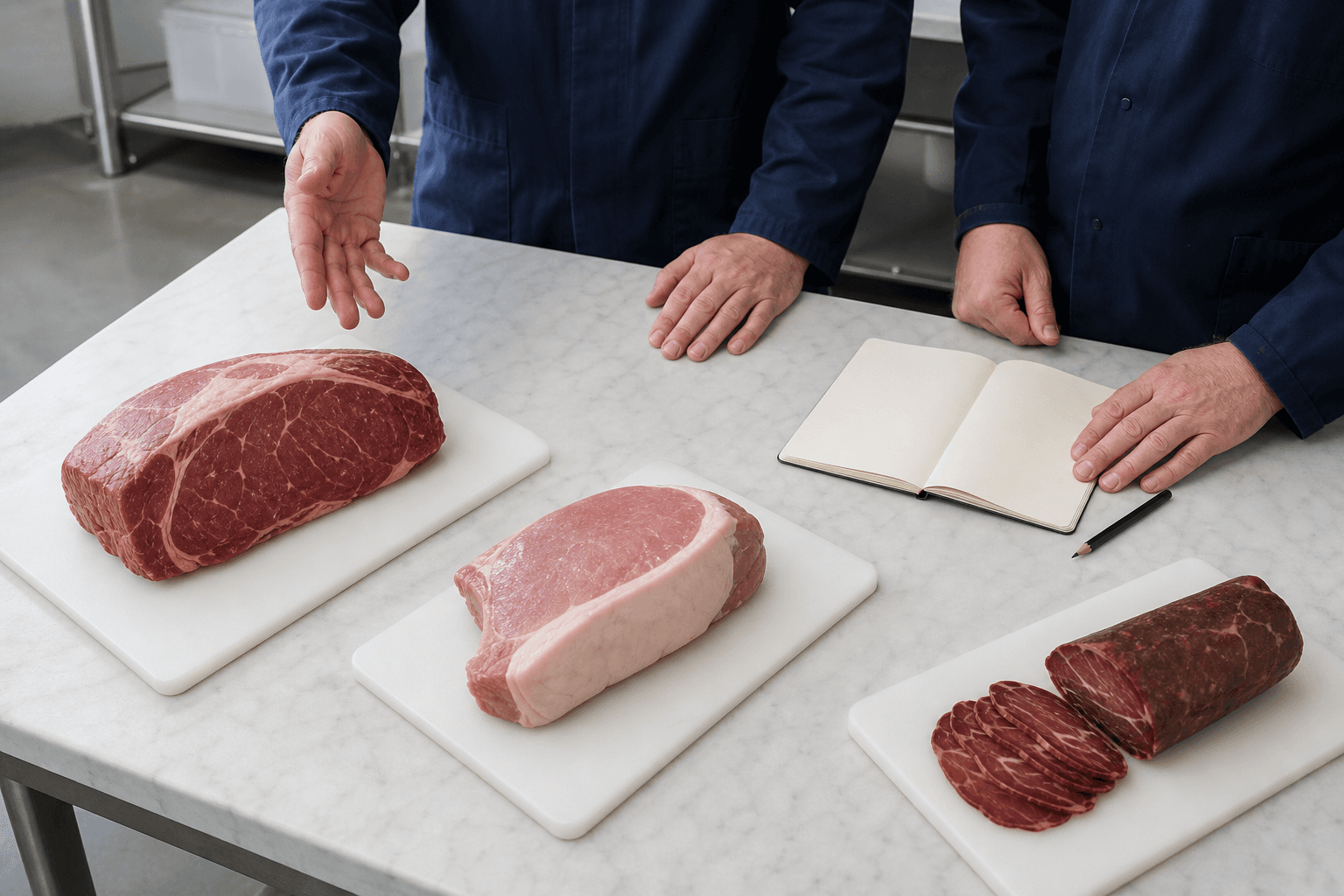
Comparative Technical Evaluation of Several Meat Products and Their Potential Applications
Editorial stock photo.

Ronny Paulusch combines an understanding of products and processes with sensor technology, international professional experience, and conceptual analysis.

More about Ronny Paulusch

The specific product

Understand characteristics. Recognize potential and limitations.

Meat is not viewed in isolation. Its origin, processing, aging, use, and communication are all interconnected.

Technical expertise does not end with the product: Its value depends not only on its claimed quality, but also on how clearly it is categorized and used.

Raw Materials and Properties

Animal species, animal category, cut, and origin serve as the starting point. Origin, texture, aging, and sensory profile influence suitability and limitations; processing and preparation determine the appropriate use.

Structure and ripening influence, among other things, texture, water-holding capacity or water distribution, and the sensory profile. Which factors are decisive in each specific case is determined based on the specific product.

Suitability Rather Than Mere Attribution

Product features are assessed realistically, with both their potential and limitations clearly identified. Applications and areas of use must be technically justified—not merely aligned with a desired positioning.

The analysis focuses on the factors relevant to the task. It does not promise a comprehensive, standard review of every conceivable characteristic.

Product knowledge serves as the foundation for well-rounded strategies for businesses, markets, and customers. A thorough understanding of the subject matter provides a more solid basis for operational and business decisions.

Interactive Product-Concept Matrix

How Product Features Influence Design Decisions.

Select one or more influencing factors. The matrix shows the resulting questions regarding application, quality definition, product range, and communication.

The presentation does not provide an automatic product evaluation. It highlights the technical issues that need to be clarified in a specific analysis.

At least one factor remains active. All posts remain readable; the selection highlights their connections.

Application

, selected

Origin shapes expectations, traditions, and potential contexts of use. However, it does not alone determine a product's suitability.

, not selected

Structure and tissue composition determine which processing and preparation methods a product is suitable for.

, not selected

Aging can alter texture, aroma, and moisture distribution. The key factor is whether the result is suitable for the intended use.

profile, not selected

Smell, taste, texture, and mouthfeel help determine the appropriate use, occasion, and expectations for a product.
Definition of Quality

, selected

Quality criteria must be appropriate for the specific product, its origin, and the actual manufacturing context.

, not selected

Texture, firmness, and the proportions of fat and connective tissue must be evaluated in relation to the intended use.

, not selected

The aging process and the result of aging must be evaluated separately. A process does not automatically serve as proof of quality.

profile, not selected

Sensory quality requires describable criteria and should not be equated solely with personal preference.

Product Line and Offerings

, selected

A product's role can vary depending on the market, target audience, and culinary context.

, not selected

Products should be categorized based on verifiable suitability—not on arbitrary quality levels.

, not selected

Different aging processes can give rise to distinct product variants, but they should not be presented as a general hierarchy.

profile, not selected

A structured sensory profile makes it easier to compare different products and position them in a clear and understandable way.

Communication

, selected

Origin is a valid argument only if it is relevant, understandable, and classified correctly from a technical standpoint.

, not selected

Terms such as "tender," "juicy," or "hearty" need to have a clear connection to texture, preparation, and cooking method.

, not selected

Processes and aging periods should only be mentioned if they are transparent and their significance for the product can be explained.

profile, not selected

Specific sensory descriptions are more reliable than general quality terms or interchangeable marketing clichés.

In a real-world product analysis, several factors come into play simultaneously. Their significance can only be determined in light of the product, the objective, and the context of use.

Analysis and Consequences

What do the findings mean for the next decision?

Understanding the concept means linking product characteristics, applications, quality definitions, product lines, and communication in such a way that technically sound decisions can be made.

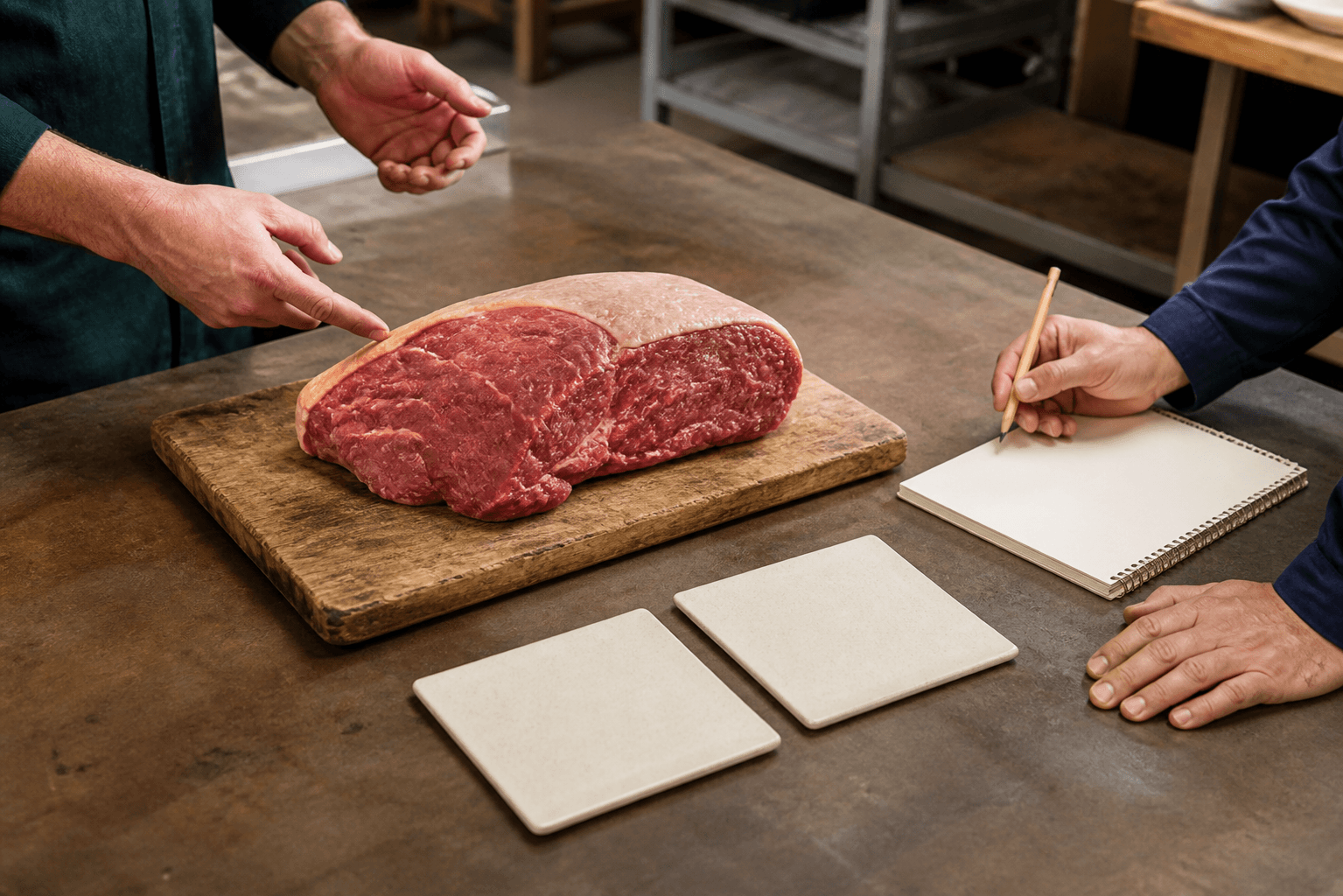
Technical Product Analysis with Working Documents to Prepare for a Conceptual Decision
Product features, usage, and communication are considered in context. Editorial stock photo.

Technical analysis and conceptual thinking go hand in hand. Viable concepts are based on an understanding of products and processes—without marketing clichés or excessive technical jargon.

Sensory observations can be documented and analyzed using Sensory-ID as needed. Kaizen Aging provides a more in-depth assessment of aging and timing; DKA Coreflex supports the classification of temperature-related preparation decisions.

  1. Clarify the product and the initial situation

    Which product is the focus? What operational or technical issue needs to be addressed—and for which market, application, or customer context is a decision needed?

  2. Classifying Characteristics, Potential, and Limitations

    What are the product's technical capabilities? What are its limitations, which applications are actually suitable, and which quality characteristics are relevant?

  3. Draw conclusions

    A clear definition of quality, the product’s potential role within the product line or offering, and technically sound communication are brought together. Which decisions can already be made, and which questions remain unanswered before further development can proceed?

  4. Document the basis for the decision

    The initial situation, key characteristics, potential and limitations, justified applications, and quality criteria can be documented on a project-by-project basis. In addition, the potential role in the proposal, communication and argumentation strategies, open issues, and recommended next steps are included.

Reliable in operation

Product lines and offerings must follow a clear logic. Operational structures, market requirements, and customer and consumer perspectives are all taken into account. Practicality in everyday use takes precedence over theoretical perfection; long-term sustainability remains the goal. The scope and depth are determined by the task at hand, not by a fixed document template.

Precision in Communication

Products must be explainable in technical terms. Clear definitions of quality and consistent lines of reasoning make complex content understandable both internally and externally. Clear communication can provide guidance and help build trust and credibility.

Experience in the Product Context

Zebu Beef Ham with a Bump

One specific example is the Zebu beef hump ham, which Ronny Paulusch developed together with Nils-Peter Czaja. The product was awarded a DLG gold medal in 2020.

Unusual starting material. Product understanding and development practices.

Areas of Application

A professional task. Different organizational contexts.

Classify Product and Quality

For product managers, development, quality assurance, and technical project teams who wish to evaluate the properties, suitable applications, and limitations of a specific product.

Aligning the Product Line and Communication

For businesses, retail, sales, the food service industry, and specialized communications that want to logically organize their product offerings and explain them consistently to customers, partners, or internal teams.

Transferring Knowledge Within Organizations

For educational partners, technical schools, academies, barbecue and cooking schools, as well as project-based international collaboration. The “Education and Didactics” section explores how technical classification is transformed into effective instruction. Specific services are tailored to each individual task.

Place it in an international context. Preserve local characteristics.

Product and quality concepts must be able to be contextualized beyond regional characteristics. National markets and culinary contexts differ. International comparability must not overshadow technical depth—and local characteristics must be preserved.

International project contexts are a potential area of application for this specialized service.

Collaboration

What decision do you need to make?

During the initial consultation, we clarify the product, the current situation, the key issues, and the desired decision. This determines what analysis is required and how the technical basis for decision-making should be structured.

If a product is subsequently to be modified, redesigned, brought to market, or incorporated into a complete product line, a separate product development project begins.