M.E.A.T. GmbH — Meat, Education, Ambition, Travel

A Didactic Meta-System for the Trades

CONEXXUS Didactics®

Structure instead of chance. Connection instead of a template.

A didactic meta-system for the skilled trades—developed through practical experience, academic research, and international teaching experience.

In the skilled trades, training determines quality, motivation, and long-term viability. CONEXXUS ensures that learning is not left to chance—but rather becomes predictable, effective, and reproducible.

Workshop & ScienceExperience & StructureTradition & ModernityTheory & Practice

Background

Why Good Education Often Fails Anyway

"That's how we've always done it."

In the skilled trades, training often follows a simple principle. This can work as long as the content, target groups, and framework conditions remain stable. But it breaks down when contexts change—new trainees, varying levels of prior knowledge, and shifting requirements. That’s when training becomes uncertain.

Not because instructors are doing a poor job—but because there is no system in place to accommodate these changes.

Typical Symptoms in Clinical Practice

different levels of learning
Loss of motivation
lack of a common thread
training that is highly dependent on the individual

The Alternative Proposal

Structure, clarity, and a clear impact.

CONEXXUS is not a rigid framework or just another training model. It is a reproducible instructional roadmap that remains grounded in practical application while elevating planning, implementation, and evaluation to a robust level.

Those who work with CONEXXUS don't rely on gut feelings—but on structure, clarity, and measurable results.

Where CONEXXUS Comes From

The workshop and science are brought together.

CONEXXUS emerged from two sources that are rarely brought together in a consistent way in the skilled trades.

Training PracticesWorkshops, training rooms, courses, and real-world training situations.
Higher Education PedagogyFurther explored at the Derek Bok Center for Teaching and Learning at Harvard University.

CONEXXUS is the result of this combination: practical experience and science. Experience and structure.

CONEXXUS Didactics Diagram Illustrating the Connection Between Knowledge, Practice, Reflection, and Didactic Models
The original CONEXXUS® system diagram illustrates connections, responsibilities, and change.

Building Bridges

From the classics to CONEXXUS.

Traditional instructional models were important pioneers—and remain so to this day. CONEXXUS builds on their strengths, adapts them to the context of the skilled trades, and combines them into a practical, application-oriented model.

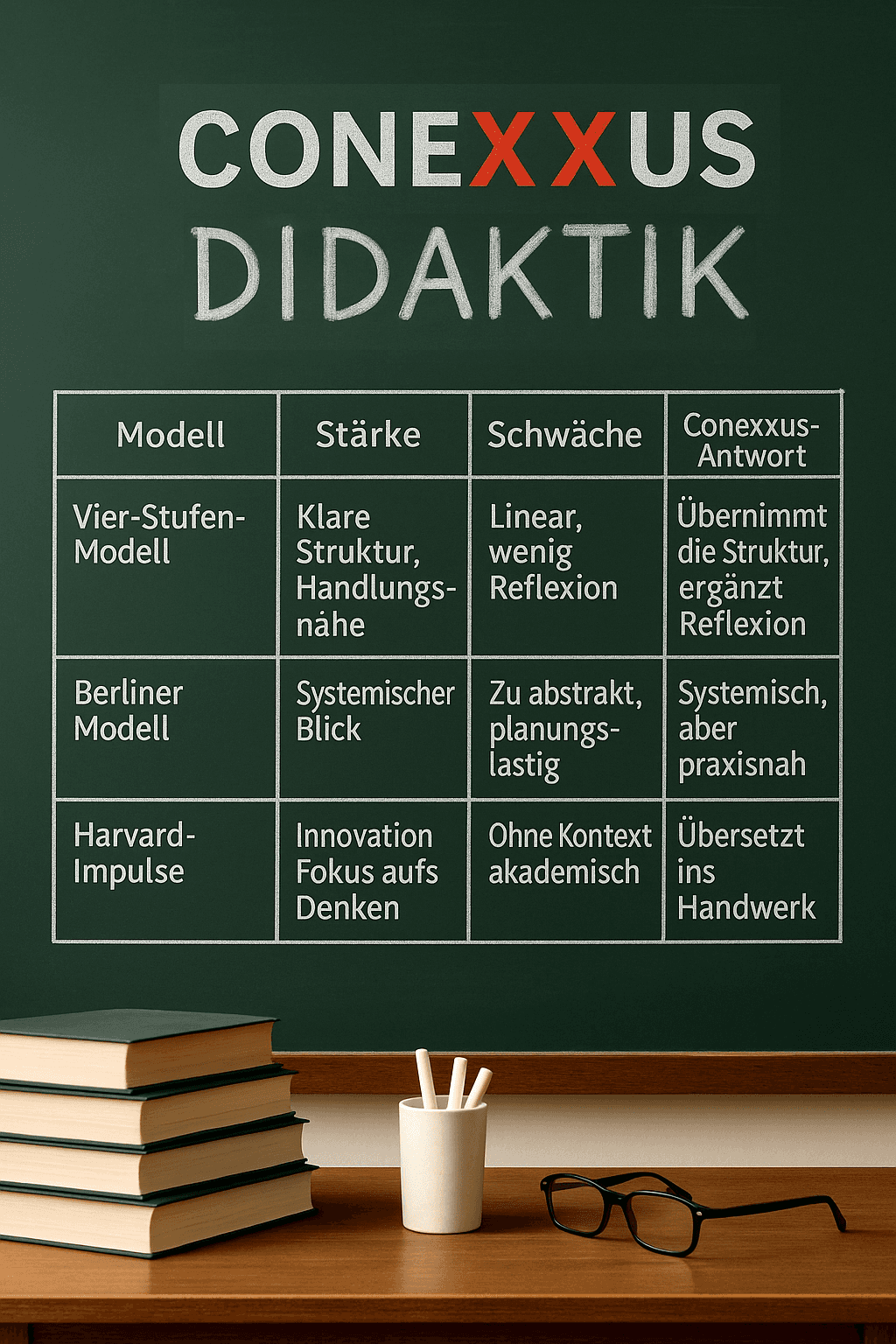
Four-Step Model

It has brought order to a situation that was previously governed by pure chance and has helped generations of instructors systematically teach practical skills. Its linear approach reaches its limits when learners have different levels of prior knowledge.

Berlin Model

It provided a scientific approach to teaching: objectives, methods, media, and framework conditions became clear. In the day-to-day practice of the trade, however, it often proved to be too abstract and overly focused on planning.

Harvard Pedagogy

Backward design, peer learning, reflection, and time architecture add a new dimension. However, without being put into practice, it remains purely academic.

What unites us is the core

CONEXXUS bridges the gap between these two extremes.

CONEXXUS incorporates the clarity of the four-step model, the systematic approach of the Berlin model, and the innovative power of the Harvard teaching methodology. These elements are not simply juxtaposed but are fused into a single model that actually works in the skilled trades.

CONEXXUS bridges the gap—between theory and practice, tradition and modernity, the workshop and academia.

CONEXXUS Pedagogy: A Comparison of the Four-Stage Model, the Berlin Model, and the Harvard Approaches

Educational Roadmap

The six-step construction plan.

CONEXXUS is broken down into six clear steps. Select a step to see how it fits into the instructional roadmap.

Think in terms of the visible result

CONEXXUS starts with the competency that should ultimately be evident. This gives training a verifiable goal rather than merely a sequence of topics.

Defining Target Competencies: CONEXXUS starts with the competency that should be evident at the end. This gives training a measurable goal rather than just a sequence of topics.

Define Evidence: Evidence clarifies how the attainment of the target competency can be identified. As a result, planning and evaluation are aligned with the same outcome.

Designing Learning Paths: Learning paths connect the starting point, subject-matter structure, and application. This allows for systematic consideration of varying levels of prior knowledge and changing requirements.

Selecting Methods and Media: Methodsand media are not used simply for the sake of variety. They are selected to align with the learning path and the desired competency.

Implementing Temporal Architecture: Shortlearning loops connect input, activation, application, and reflection. Time thus becomes a consciously designed component of the learning process.

Evaluation and Iteration: Evaluation and improvement are the norm, not the exception. This ensures that the model remains adaptable and can respond to different contexts within the skilled trades.


Basic Principles

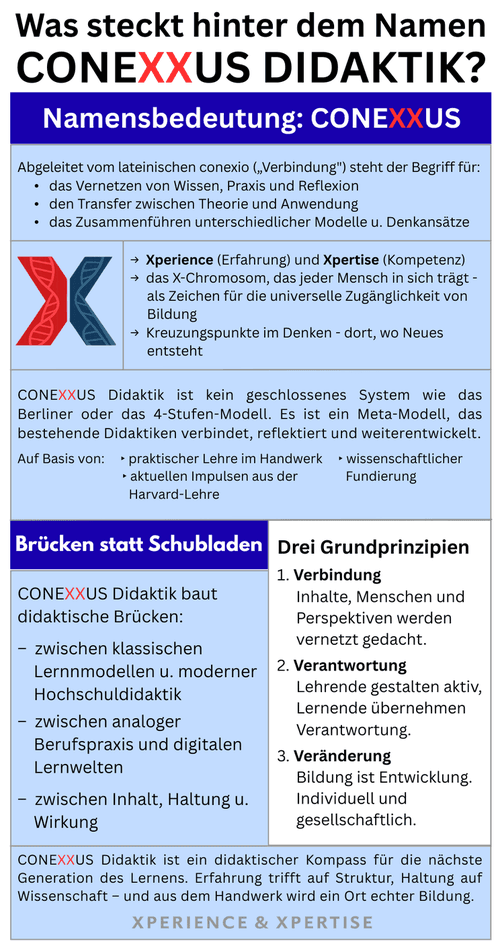
The DNA of CONEXXUS.

These fundamental principles ensure that the model remains dynamic. It is not a rigid framework, but rather a flexible one that adapts to different contexts within the skilled trades.
Plan with the goal in mind

What competency should be evident in the end? Planning begins with this question and leads from there back to the learning path.

Backward Design: Whatcompetency should be evident by the end? Planning begins with this question and works backward from there to map out the learning path.

Learning to Think: Learninginvolves more than mere reproduction. Subject-specific decisions are analyzed, justified, and applied to new situations.

Peer learning, feedback, and shifting perspectives are all included. Learning is organized as a combination of experience, exchange, and professional reflection.

Temporal Architecture: Short, clearly structured learning cycles organize time and make practical application an integral part of the training.

Iteration: Aftereach unit, we evaluate and refine the program. This ensures that CONEXXUS remains a flexible framework rather than a rigid structure.

Development & Responsibility

From practice, methodology, and international teaching practices.

CONEXXUS is the result of Ronny Paulusch’s ongoing work in educational development, based on practical training experience, systematic teaching methods, and international teaching practices. Designed for application-oriented training in the skilled trades.

“A system for people who take their education seriously.”Not as a duty. But as a responsibility.

Follow-ups

Apply, explore, and teach didactics.

CONEXXUS Didactics is not a concept for perfect class schedules. It combines subject-specific structure with application-oriented instruction and leads to appropriate areas of specialization.